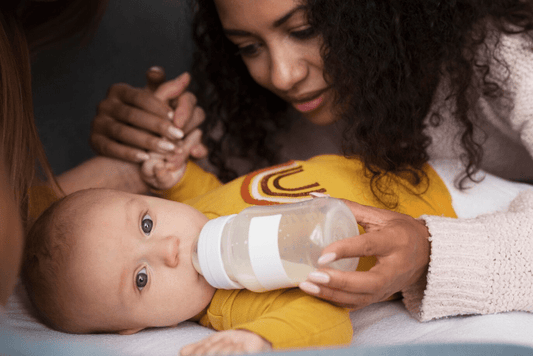
Around six months, feeding can suddenly feel like a whole new routine.
Your baby may still be drinking several bottles a day, but now there are tiny spoonfuls of avocado, mashed vegetables, soft fruit, or oatmeal entering the picture too. Suddenly, parents are wondering:
Should I offer solids before or after a bottle? How much should my baby eat? Should bottles become smaller? And when does food actually replace milk?
The short answer is: the transition happens gradually.
Starting solids is less about replacing milk overnight and more about giving your baby a new way to explore food.
Milk Is Still a Big Part of the Day
When solids are introduced, breast milk or infant formula generally remains an important source of nutrition.
That means you don't need to look at a small serving of food and think, “That's lunch now.”
At first, your baby's solids may be just a few spoonfuls. Some days they may eat enthusiastically, while other days they may barely taste anything.
That's normal.
The early months of solids are largely about learning: new flavors, textures, smells, temperatures, and the mechanics of moving food around the mouth.
So, What Actually Changes?
The biggest change isn't necessarily how much your baby eats. It's how you organize the day.
Instead of a routine built almost entirely around bottles, you may gradually have several different feeding moments:
Bottle → solids → bottle → solids → bottle
The exact schedule will depend on your baby, but adding solids means feeding can become more flexible.
You may also notice that your baby starts becoming more interested in what everyone else is eating. Suddenly, breakfast isn't just breakfast. It's something worth watching, grabbing, touching, and eventually tasting.
Don't Expect Every Meal to Be a “Meal”
One of the easiest traps for parents is comparing a baby's portion to an adult meal.
At six months, a meal doesn't have to mean a full bowl of food.
A few bites can be a successful meal.
Your baby might eat two spoonfuls one day and several more the next. They might love banana but refuse it three days later. They might happily open their mouth for one food and immediately turn away from another.
Rather than focusing on finishing a certain amount, think about exposure and exploration.
What About Bottle Timing?
There isn't one universal schedule that every baby needs to follow.
Some parents offer a bottle first and solids afterward. Others find that offering solids when their baby isn't completely full works better.
What matters most is paying attention to your baby's cues.
If your baby is extremely hungry, they may have very little patience for experimenting with a new food. If they're completely full, they may not be interested either.
Finding that comfortable middle ground can take some trial and error.
Your Baby May Get Messier Before Getting Better
Solids also introduce something that bottles never did:
mess.
Food gets pushed out of the mouth. Hands go into bowls. Spoons get thrown. Avocado ends up everywhere.
This isn't necessarily a sign that your baby isn't eating properly. Babies are learning how food works, and some of that learning happens through touching, smelling, squishing, and yes, dropping it.
The messy stage is part of the process.
The Routine Will Keep Changing
The six-month feeding routine isn't a schedule you'll necessarily follow for the next six months.
As your baby becomes more comfortable with solids, their portions, food variety, and feeding frequency will gradually evolve. Teething, growth spurts, illness, development, and changes in sleep can all affect appetite too.
That's why flexibility is useful.
Instead of asking, “What should my baby's exact feeding schedule be?”, it can be more helpful to ask:
“How can I create a routine that leaves room for my baby's changing needs?”
Think of Solids as an Addition, Not a Replacement
The biggest mindset shift at six months is understanding that starting solids doesn't mean your baby suddenly moves from “milk-fed” to “food-fed.”
It's a transition.
Milk continues to play an important role while your baby gradually learns how to eat, develops new skills, and becomes familiar with family foods.
There will be exciting meals, rejected meals, messy meals, and days when your baby seems interested in absolutely nothing.
That's okay.
You're not trying to create a perfect feeding schedule. You're helping your baby build a relationship with food, one bite at a time.